Friday, June 27, 2014
June Reader Questions
Dear Green Derm,
I hope you can help me with this. I use the Arcona Tabula Pads every morning and night to exfoliate my skin. My girlfriend says this is a toner and it doesn't actually exfoliate yet I SEE the dead skin cells and flakes with my own eyes. This is all I use to clean my skin and I'm really curious why I see all this stuff come off if it doesn't exfoliate, provide me some clarity?
Your girlfriend is half right. Arcona's pads can be simplified as toner soaked cotton pads. Toners when used alone can condition your skin and disinfect. It's a big of a stretch to call it cleansing, but not too far fetched as the pads indeed help get a lot of stuff off your face similar to cleansing wipes. The reason your girlfriend is only half-right is because of two reasons:
1. This product contains lactic acid which offers chemical exfoliation.
2. The cotton pads when swiped over skin offers physical exfoliation.
This is why you're seeing the dead skin accumulation on the pads. Something I want to point out is, if this is all your use to clean your skin and you're seeing dead skin regularly with cleansing, you should consider investing in a good cleanser which will help clean deep down (some with enzymes or acids can also continue to break down dead skin cells).
Hello!
I have keratosis pilaris on my legs and as it is summer, I would like to work to get rid of this so I can go to the beach or pool in confidence instead of hiding behind wraps. Are there any good solutions?
Keratosis Pilaris is firstly a very common skin condition that many people have, so you should definitely not feel like you have to hide. Now I have good news and bad news. The good news is that this condition is often benign and will fade as you get older (in fact, a lot of women say it significantly goes away with hormonal changes during their first pregnancy). The bad news is that it is difficult to fully treat so the common method of treatment is managing and improving the condition. In terms of solutions, dry skin tends to intensify this condition so moisturize your skin. The best option is to use a moisturizer that also contains an exfoliant to break through that excess layer of accumulated protein. There is a good product on the market that I am not associated with in any way called AmLactin which is an Alpha-Hydroxy moisturizer especially made for this condition. It isn't green but it's the best product on the market (in my opinion) to help manage this.
I have a daughter who will inherit and her parents bad skin genes (both of us had terrible teenage skin), are there any steps I can take to prevent this?
Prevent is smart but depending on how old she is right now, be careful not to go overboard. Most young kids have resilient, durable skin that shouldn't be tinkered with too much. I recommend gentle cleansing and a good sunscreen as preventive measures that will go far in her adult life. Beyond that, I think you two should look for a dermatologist so there is a professional who will be prepared to help your daughter when the time comes and her skin begins to change. Also start preparing a list of the do's and don'ts that you wish you could have had when you were going through these things so your daughter can avoid making the mistakes you've made (such as picking at pimples, using 5% BP solutions, so forth) and keep only the good behavior. Finally, no one has perfect skin and going through that at times painful transition from childhood to adulthood is a part of life. Your daughter will be fine and she will have parents who will serve as a resourceful pool of knowledge when she does need help.

Saturday, February 8, 2014
First Impressions: Skin Brighteners and Correctors
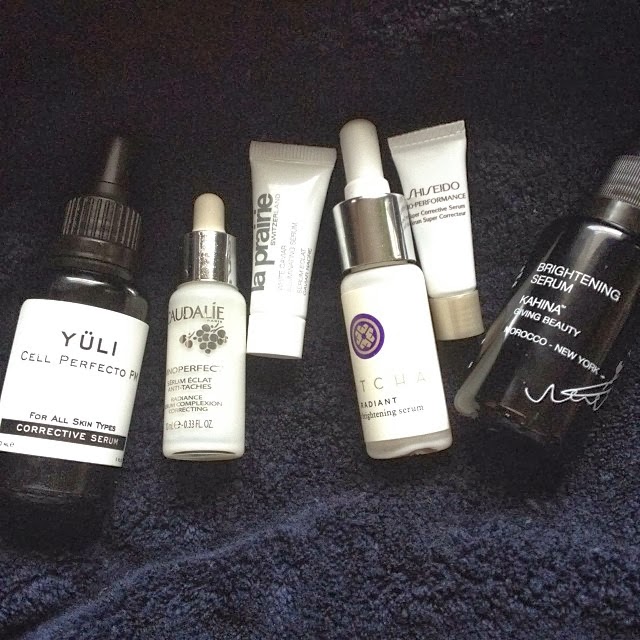
For the past two weeks I've been playing with a variety of the most raved about brighteners and correctors from ultra premium brands both green and not green. Brighteners and Correctors are a very complicated category because it is easy to confuse what the products are supposed to do. Brighteners will enhance skin, making it appear more even and "lit", which is beneficial for those who have dull and uneven skin. A lot of brighteners fade color with acids or melanin suppressants. Correctors focus on the damaged skin that contributes to the flawed complexion so they work on turning over damaged skin and making it healthy and normal again. Results usually come more quickly with brighteners because they are meant for the more superficial surface level issues while correctors often work on deeper damage.. While it is too early to call out the performers, I thought I'd post a little about the first impressions.
Texture and scent:
Texture and scent:
Shiseido and La Prairie are very similar to each other. Their serums both promise brightening with Shiseido going a step further to offer correcting. They're both light and sink into skin easily thanks to alcohol and silicones which there is a lot of. The fragrance is as expected for a high-end brand. La Prairie has sparkle pigments that resemble a subtle glitter bomb which probably gives a temporary luminosity to skin until it is washed off.
Caudalie and Tatcha are very similar in that theirs are both very fluid, milky serums with nice fragrances. The fragrances Caudalie uses in their products are so good that they've been bottled into perfumes but unfortunately, similar to Shiseido and La Prairie, they're synthetic while Tatcha uses natural fragrance.
Kahina is also milky but a little thicker than the others. The scent is very light compared to the others but there does seem to be a mint smell.
Yuli has a plant oil base but the texture is actually more of a clear gel because of the other ingredients. This gel texture enables some material to be suspended which supposedly gives off activity over time and is supposed to be massaged onto skin to penetrate and stimulate - smart! The scent is herbal and light.
Skin Response:
After initial tests and 2 week trial runs, if I were to pick the ones that I predict would deliver the most results with extended use, I would say Tatcha's Deep Brightening Serum and Yuli Cell Perfecto. These two felt like they did the most in this short amount of time so I think given a more extended run, the results will probably keep coming.
I'll post a full rundown on these products when I've had more time but for those of you looking for some direction now, I thought this might be helpful.
Sunday, December 22, 2013
My take on Colloidal Silver
I have been receiving e-mails for a while now asking about colloidal silver; whether it is safe, if it will turn skin blue, and so forth. The natural beauty community seems to have a neutral to negative take on this ingredient based on comments I've read online. So rather than me writing out what I know about colloidal silver, I thought it may be more productive to directly answer or examine some beliefs about this ingredient.
What is it?
Think of colloidal silver as a suspension of tiny silver particles evenly dispersed in water.
What does it do?
Colloidal silver is used for many reasons, however in skincare products, it has an anti-bacterial and anti-viral function that acts as a natural preservative and helps to kill bacteria.
What is the problem with it?
For most people, the problem has more to do with the past than with the product itself. When it first came out, there were all sorts of health claims for colloidal silver including as a dietary supplement, HIV/AIDS cure, herpes vaccine, etc. However much of these claims are unsubstantiated through scientific testing. Furthermore, there were no dosages so people ingested large quantities to cure everything from the common cold to allergies. The build up of large doses of colloidal silver when ingested over time can lead to a condition called Argyria, which gives a blue discoloration to skin, eyes, nails, and other membranes. Argyria doesn't have any real health impacts although the appearance can be extremely disconcerting.
So what happened?
Because of these isolated cases, the FDA realized that there needed to be measures in place as this was being used as a form of oral medication without any tested medical results to back the claims. After testing, they concluded that much of the claims could not be proven true and enacted sweeping measures to restrict all manufacturers of colloidal silver who made these claims.
Why are some skincare brands using it now?
Although colloidal silver has never proven to be a legitimate source of fighting off the claims manufacturers initially suggested, it does have real efficacy as an anti-bacterial that inhibits the growth of bacteria, germs, and viruses. As it is a pure and clean ingredient (using only silver), it is considered a very natural preservative.
Why don't they use other preservatives?
As a preservative, colloidal silver delivers great results and is also fairly beneficial for the skin. This makes them exceptional as they have dual functions to both protect the formula from spoiling and provide benefit for skin. It seems that commonly detractors of any ingredient in natural beauty will make the following claims: 1) The ingredient is cheap 2) It isn't pure/natural 3) It is bad for sensitive skin!
So let's address those claims:
1. Colloidal silver is much more expensive than typical food grade preservatives (which are in turn more expensive than paraben/phenoxyethanol) because of the fact that it is a high quality and effective ingredient that uses actual silver. There I don't believe skincare lines use this ingredient to skirt the issue of cost.
In fact there is nothing budget-friendly about colloidal silver at all, the recently launched La Potion Infinie Argentum is a $245 jar of cream that is said to have anti-aging, hydrating, and anti-bacterial impact on skin. It's key ingredient is colloidal silver. Similarly, Julisis, another expensive line uses colloidal silver across its silver essence line. In this case, they're showing off their access to and use of colloidal silver as an attractive ingredient.
3. Unless you have an actual allergy to colloidal silver, then it won't irritate your skin. In fact many food good preservatives have been shown to have the potential to cause irritation, eye allergies, dermatitis in smaller concentrations.
But aren't other preservatives safer?
Much of the safety concern related to colloidal silver applies to extreme cases of regular ingestion. No such results have ever occurred from topical application because it just isn't realistic. This fear is akin to the fear of contracting HIV from mouth-to-mouth contact, it is misguided. Furthermore, if we're going to access safety through regular consumption, food grade preservatives don't fare any better. For instance, sodium benzoate which is used in Kahina products has been shown to have potential carcinogenic effect when combined with Vitamin C, and in large doses can impact nerve health (this was the ingredient that got Skinnygirl Margaritas into trouble a while back). Benzyl Benzoate used in Tata Harper products has been used in insecticides and has been shown to have potentially irritating effects including dermatitis on human skin.
The takeaway is that none of these preservatives are meant to be ingested straight, so when it happens there may very likely be side effects that aren't favorable. The point isn't to say other preservatives are worse, but rather to point out colloidal silver is not more dangerous than any of the other preservatives most consumers including natural green beauties happily use every day.
So why does the FDA go hard after this?
The FDA goes hard after those who continue to market colloidal silver as an oral medication that cures those unproven claims, not skincare companies who use colloidal silver as a preservative. In the same way that if the ingestion of the food-grade preservative potassium sorbate took off for unproven claims, the FDA would probably go after that as well.
On the flip side, the FDA has approved MANY products that incorporate colloidal silver for its anti-bacterial properties.
What is your take?
The pictures of people with Argyria are hard to look at, so I get the fear. But all those cases came about from a lack of education, we're more educated now. And we now know that Argyria comes from chronic long term ingestion of colloidal silver, not through topical application of skincare. With the sufficient studies that the FDA has done for the approval of topical usage of colloidal silver, I'm very comfortable with this preservative. Colloidal silver helps to maintain the stability of products and unlike most preservatives, actually seems to have skin benefits. If you're not comfortable with colloidal silver yet, look for formulas where it is listed toward the end of the ingredients listing as those concentrations are incredibly harmless.
Wednesday, December 4, 2013
Do toners do anything?
"It seems every line is coming out with a toner/spray for face. Can you tell me if this is needed? I've heard that toners are either essential or a total waste of money, and I'd like to hear your thoughts. La Bella Figura and May Lindstrom have both said in the past that these sprays essentially don't do anything, yet they both have sprays now so I'm a little confused. Are they trying to make money or should I expect to see benefits?"
- Jasmine
Hello Jasmine, I get this question a lot. First let's figure out what toners are because the definition is a bit loose. Toners have an umbrella term that represents astringents, make-up removers, and primers for serums. Classical toners tend to have a high alcohol composition which helps as an additional cleanse. This helps remove impurities so serums can better penetrate the skin. Fancier toners will also have extracts that are beneficial to skin to ideally make it more receptive to moisture and treatments. Green beauty toners are often formulated with floral waters which in my opinion excel beyond the classical toners because they're much more nutrient rich which means your skin can receive more benefits.
Now - what do they do? In the way that a cleanser should cleanser, a moisturizer should moisturize, a toner would tone. This means ideally it should help condition your skin which can include any of the following:
- Jasmine
Hello Jasmine, I get this question a lot. First let's figure out what toners are because the definition is a bit loose. Toners have an umbrella term that represents astringents, make-up removers, and primers for serums. Classical toners tend to have a high alcohol composition which helps as an additional cleanse. This helps remove impurities so serums can better penetrate the skin. Fancier toners will also have extracts that are beneficial to skin to ideally make it more receptive to moisture and treatments. Green beauty toners are often formulated with floral waters which in my opinion excel beyond the classical toners because they're much more nutrient rich which means your skin can receive more benefits.
Now - what do they do? In the way that a cleanser should cleanser, a moisturizer should moisturize, a toner would tone. This means ideally it should help condition your skin which can include any of the following:
- improving moisture levels and hydration retention
- enhancing skin texture
- managing complexion
- refreshing dull skin
- increasing absorption rate of serums
Personally, I believe a well formulated, high quality toner is very helpful for good skin and I use them in my daily regimen. I won't argue with those who say it is a waste of money because toners don't give instant results that cleansers or moisturizers do, where with those products you'll feel cleansed and moisturized, it's hard to quantify the feeling of "toned". I will say this, I consider a good toner essential to giving me my best skin and going without it does indeed hinder the performance of every other product in my regimen. I can see/feel when my skin getting better after regularly using a toner versus when I do not. It's the subtleties. I consider it similar to drinking tea and juices, your skin is not going to show anything right away but stick with it and your skin will get that glow. Juicers and tea drinkers should know what I'm talking about.
As for La Bella Figura and May Lindstrom, I can't tell you what their intents are but if they said that, I'd guess that it's a mix of the two. Perhaps they changed their minds from when they originally had that stance and they now believe that toners are effective products. It sure doesn't hurt that they're selling a product. I do think it's a bad business move for them ti say that and then end up producing a toner, because it makes me wonder how authentic it is when they champion their product when they don't even seem to believe in it. Though keep in mind that neither of these brands have a dermatological or chemistry background so perhaps as they gained more experience in this field and had exposure to more information, their perspective on this changed. I'd respect them more if they didn't disparage this when others were selling toners but are now fully embracing it when they have a toner to sell.
Regardless, some good ingredients to look for in toners depend on your skin type. Firstly, I recommend floral waters because they contain a lot of nutrients including antioxidants and minerals that your skin can absorb. Look for the ingredients that can have anti-inflammation properties because it helps counter all types of problems like aging, redness, and breakouts. I personally don't like for toners to contain any oils because it should be light. In order to use oils (which are mainly used for fragrance) and maintain a light texture, toners often use emulsifiers and my personal philosophy is that there should not be too many chemicals in the toner especially if it is a spray since you will ingest some of it (through your nose). For dry skin, look for hyaluronic acid that is biologically identical to the ones already present in our skin, as a lot of chemical hyaluronic acid is actually not able to be effectively absorbed. Go for smaller particles that will absorb easily into skin, try to stay away from alcohol not only for what it can do to skin but the fact that it also destroys beneficial ingredients. Because this is a very pure product, try to buy products where the first five ingredients are organic or wild grown.
Beyond this guideline, I'd urge you to give toners a good long test run to help make up your mind.
Saturday, November 23, 2013
Greatest Pet Peeve: Sensitive Skin
There is perhaps no statement that causes me to to shut down quicker than when someone says "I have sensitive skin". This most happens when asking for product recommendations or general advice on skincare. While I know nothing is meant by this comment, from a professional perspective (and hearing it ALL THE TIME), I can't help but have a visceral reaction to it. I urge you to read this with an open mind if you've used this phrase before with your dermatologist because it could help you communicate better with your dermatologist. Here's why:
It doesn't mean what you think it means. Sensitive skin is actually more of a marketing term that some companies used in the early 90s that really took off. Initially the intention was to sell products that would relieve redness and inflammation. But consumers took this phrase and through a continuous consumer-led cycle redefined this to stand for "products suitable for sensitive skin", giving the impression that sensitive skin is a "skin category" - which it isn't. The skin is a spectrum and there is no set guideline for when it is sensitive and when it is normal, after all, do you ever hear the phrase "products suitable for insensitive skin"?
- It is a non-quantifiable word that is utterly meaningless in helping me access and diagnose your skin. Sensitive skin means your skin has had a sensitivity to something (if it does not, you shouldn't say you have sensitive skin).Those who have skin that is reactive to lot of products most often have a sensitivity to a common ingredient. It is not helpful to say you have sensitive skin but if you can follow it with what you are actually sensitive to (synthetic fragrance, silicones, etc), and what it does to your skin, that would help.
- It is overused. 80% of women claim to have sensitive skin, if we were to take this statistically, it really means the "majority of people have sensitive skin" which given the definition of sensitive is statistically impossible. The real world implication is that most people who say they have sensitive skin just have normal skin since they're in the majority. This really just goes back to my former statement that there is no quantifiable measure for sensitive skin so everyone uses it in different ways that in the end don't really represent anything.
So think about it from your dermatologist or skincare professional's view. 8 in 10 patients they see say their skin is sensitive, after a while of this what this means is that they're numb to the word rendering it ineffective. Anyone can have a sensitivity to anything. I once heard a girl say her skin was allergic to water, true story. So whether a patient reports having sensitive skin or not, as dermatologists we still have to go in preparing for the possibility that there are some things you could be sensitive to and some things you won't be.
Psychologically, the reason a lot of people use sensitive skin, is as a crutch against the possibility of an adverse reaction and for companies/professionals to provide more accountability/attention to their specific skin history. So although the word to us is meaningless, when we hear someone use it, we're already mentally categorizing the patient as potentially high-maintenance and problematic. For the patient, using this strategy is also not advantageous because most of the time the response you'll hear back is "then use less of this product" or "discontinue use if irritation occurs" which is pretty general knowledge that should be a given.
So next time you visit your derm or talk to a skincare consultant, try to explain what you mean if you truly believe your skin is "sensitive" - what is it sensitive to? what are the ingredients you need to avoid because of this? what are the reactions and what interactions do you believe led to this reaction? The result is that you'll give us more to work with so we can better help you and you'll actually end up getting the information you were looking for.
So next time you visit your derm or talk to a skincare consultant, try to explain what you mean if you truly believe your skin is "sensitive" - what is it sensitive to? what are the ingredients you need to avoid because of this? what are the reactions and what interactions do you believe led to this reaction? The result is that you'll give us more to work with so we can better help you and you'll actually end up getting the information you were looking for.
Monday, October 21, 2013
Get skin ready for Fall-Winter
Break out the sweaters, fall is here! It's a season I've come to love as it means I can walk along to campus to gorgeous autumn foliage. It also means that it's time to transition your skin care. I've compiled some tips to help prepare your skin for the colder months to ensure you maintain that radiance.

1. Humidifier
Winter is notorious for dry and chapped skin. Invest in a quality humidifier to put moisture back into the air. Not only is this wonderful for maintaining skin moisture, it also keeps your immune system in shape to fend off the spread of seasonal diseases and viruses. I personally prefer the humidifiers that allow you to adjust strength and temperature because there is no "one size fits all". I like to set the humidifier slightly hotter than room temperature so that I don't need to use the heater as much which helps maintain the natural moisture in the air.

2. Exfoliate
It's not just the lack of sun making you feel that your skin is more dull and lifeless during the colder months, its actually the combination of the drier climate and application of more occlusive moisturizers that can keep dead skin cells from turning over. This contributes to the dull, sallow complexion and can even clog pores. May Lindstrom's The Clean Dirt is one of the most well known green exfoliators out there. Some people call this a cleanser, she calls it a cleansing clay, but I think of it as a clean version of Bobbi Brown's Buffing Beads except with spices to stimulate circulation. This is sure to slough off dead skin cells. Sensitive skins should not use this more than twice a week to prevent the possibility of irritation.
 |
| Photo from Eva Chen's Instagram |
3. Face Oil
I was surprised to see on my instragram feed over the weekend that Lucky's new EIC, Eva Chen posted the above picture with the caption: I know it's officially fall when I start using face oils. These are my four favorites!
It's good to see a face oils get recognized in the mainstream because they're so efficient. A few drops provides the moisture capabilities of a moisturizer while also feeding skin with a lot of nutrition. It is really the best combination of a serum + moisturiser. And because it is so pure and concentrated, the chances of congestion and irritation are actually less than using a cream moisturiser which tends to use more chemicals, emulsifiers, waxes, etc which can clog pores and irritate skin.
To read more about picking oils, read my post on how not all oils are equal and for those with acne-prone skin who are taking the plunge into oils, this is a list of recommended face oils.
 |
| Photo from YULI's Facebook |
4. Anti-irritants
Our skin is sensitive to temperature extremes. In brisk, harsh cold climates, the winds and snow can feel like whips lashing against the delicate skin. I remember a key sign of winter when I was a child was when my dad would bring home hand balms. Balms not only help skin retain moisture, but their thick barrier also forms a protective shield against the harsh environmental exposure.
I really like YULI's Cocoon Elixir because it contains anti-irritants that help to relieve redness and soothe skin with calming calendula, chamomile, and healing lavender. And for when skin is really problematic, it contains anti-inflammatories to treat those painful itches caused by dry harsh air.
 |
| Photo from Salonzola Instagram |
5. Protect your lips
This should be obvious as your lips are one of the most exposed parts of your face. To prevent chapped, dry lips, I recommend an occlusive balm. A personal favorite is Intelligent Nutrient's Lip Delivery which features beeswax, coconut oil, and shea butter which are among the most powerful moisture retaining ingredients by far comparable to even their chemical sibling petrolatum. I also love that besides just waxes and thick oils, it has antioxidants and real nutrients which makes it almost like a balm-serum.
 |
| Photo from I Am Natural Instagram |
If your lips are beyond the need for a simple moisture fix, use YULI's Cellular Lip Conditioner to heal and treat dry/cracked lips and layer it under your balm to fix damaged lips and soak in moisture. It's called a super-concentrated lip serum which means there are more actives that repair lips beyond forming a barrier.
Both products are not only natural & mostly organic but they're food-grade and safe enough for pregnant women which is so important because upwards of 80% of lip products are ingested.
 |
| Photo from Clementine Fields Instagram |
Everyone should use a moisturiser but if you have dry skin, it is even more important to step up moisturisers in the winter to keep your skin in check. I personally like Tata Harper's moisturisers, I buy the Repairative Moisturiser (above) for my mom as it is suited for dry/mature skin, while during the coldest bits of winter, I apply a pump of the Rebuilding Moisturiser over dry patches around my mouth. My favorite quality about the moisturisers from this line is that they're packed with skin restoring ingredients. Some moisturisers just help lock in hydration but Tata definitely makes hers a hybrid between moisturiser/anti-aging treatment. I almost see no need to add an anti-aging treatment on top of her creams for this reason.
Some people don't like that the Tata Harper line is very fragrant but I consider it a step above other companies that use parfums (synthetic fragrance). So if you don't have any sensitivities to the fragrance she uses, I consider her moisturisers really effective for dry skin.
--
Have any questions over how to transition your skincare regimen to winter? Ask in the comments!
Thursday, October 10, 2013
Green Beauties, Your Makeup Could be Causing Your Breakout
One of the greatest ironies I see in the green beauty world is women with acne switching to green makeup in hopes of getting their skin under control. While it is true that mainstream beauty brands use more chemicals and toxic ingredients, what causes acne are suffocating or irritating ingredients such as fragrance, mineral oil, and silicones. All this aside, switching from these ingredients to lines that use coconut oil and waxes is not going to be better for your skin.
I would almost say as a rule that if you have blemish prone skin, do NOT use RMS Beauty which uses coconut oil in nearly everything. My parents have seen many patients who go to them with massive clogged pores and breakouts after switching to "holistic natural" products and cleansing/moisturizing their skin with these thick oils. I'm not saying coconut oil is a bad ingredient, not at all, if you have dry skin or skin that just doesn't break out, you will even find it to be very useful but for people who break out, you should absolutely refrain from using this on your skin. The moisturizing properties aren't worth it because it will break you out eventually.
So that is makeup itself, now let's talk about how we remove makeup. Many green beauties swear by oil cleansing. I can see why, it works wonders in removing stubborn makeup as the oil pulls products from skin that water cannot. However, if your skin is prone to breakouts, I would definitely advise against just oil cleansing. No matter how well you wash, there will be residue left over that accumulates in your pores leading to more breakouts down the road. If you want the performance of a oil cleanse, I suggest the double cleanse method. Use an oil to clean your face, wash it as much as possible. Then go over it with a traditional cleanser that can take off the left over oil and actually clean out the other grime in your skin that oils do not remove.
Remember that just because something is holistic and green, it doesn't mean that it is suitable for you. Acne is a treatable condition, for most people who have those persistent but not severe types of acne, it is nearly always preventable by changing a few things in their routine.
Subscribe to:
Posts (Atom)