Dear Friends,
I started this blog almost 4 years ago as a medical student in dermatology. Unlike other blogs, I didn't utilize fancy visuals or full blown product pitches, the way I operated was simple: I just provided my insight with the intention of being helpful.
The beauty industry often lacks clarity and is filled with unsubstantiated claims or overblown promises. This blog has served as an outlet for me to dispel myths, and provide actual guidance. I did not know if writing from my point of view, free of marketing language and the "glam" would find an audience. Years later, I still receive around 2-3 e-mails a day asking what I think about a product or how a routine can be improved. To say I am amazed by the response is an understatement.
When I was attacked by a brand you came to my support and provided very kind words that motivated me to continue. On the flip side of honesty and that "integrity" is that sometimes a brand may be threatened or hurt by an opinion. I've been blocked, received threatening DMs and even legal notices. It is all very draining and my interest in continuing this blog waned.
In the fall of 2016, I was approached by a website Garçon's World with their mission of including guys in the conversation of health and wellness. It immediately caught my attention as men just never seemed to move beyond the lifestyle pages of GQ the way that women have created communities such as Into The Gloss and GOOP. Through continued conversation, I realized that Garçon's World would be the ideal platform for me to continue my goal of providing honest insight to a larger audience.
I welcome each and every one of you to follow me (and the continuation of this blog) over on Garçon's World. Waiting for you right now is my latest post on reader questions where I tackle retinols, acne treatments and exfoliation. I look forward to continuing the journey with you all over there!
As always, messages sent to me will continue to be answered even if it takes a while for me to get to them!
Wednesday, February 8, 2017

Monday, February 8, 2016
Reader Questions: Formula Edition
It's been a while since I've been able to post on here. Mostly school has kept me pretty busy and the time I'd spend writing a post is now relegated to answering the growing numbers of e-mails. I'm going to try and organize your reader questions into categories so they're easy to find if you ever need to come back to them at a later date.
This edition is about common ingredients in formulas that many of you had questions about.
What should I look for a in face oil for the most hydration?
I get this type of question a lot and the reason I'm posting it is to help distinguish the difference: oils help with dry skin and they can seal in hydration. They're products that are good for DRY skin which is characterized by a lack of natural oils on skin surface. The way they might contribute to hydration is by sealing in moisture and for that, you'll need a a formula that has a good mix of carrier oils with larger molecular size that don't penetrate as deeply as some essential oils.
Water based products with glycerin and hyaluronic acid are what you're looking for if the intent is to help with maximizing hydration. The best time to put on products for hydration is within 3 minutes of showering. And as oils can help seal in the moisture (depending on the formula), make sure your skin is damp when they are applied.
I'm looking for a natural retinol or alternative, what are my green product options?
I've made a conscious effort to stay away from specific product analysis on here due to what transpired when I had questioned La Bella Figura's claimed Vitamin C effectiveness (which despite some plants that contain Vitamin C, does not actually contain active Vitamin C in the formula!) in Modern Radiance Concentrate which led to them harassing and attacking me. With that out of the way, the fact is that I do receive questions about new products and popular products ALL THE TIME and I understand many of you want to know my honest feedback so please - take what I am saying about this and all future specific products as purely my opinion.
There are some products that use retinol such as Osmosis and Arcona. Both use the chemical form which isn't bad, but most of you who e-mail me are making an effort to avoid them. Although neither Osmosis nor Arcona are fully 'green', their formula in general is pretty good as far as retinol based products go.
Sunday Riley has the Luna oil that contains transretinol ester which is also a chemical form in an oil base. What I don't like about it is the fact that there is blue coloring in the formula and I found her 'reasoning' behind it (to tell you when it is absorbed) to be frivolous and invalid due to the fact that dyes simply do not work as absorption indicators and they're also not included with the rest of the line (so does that mean absorption of her other products including 3 other face oils, aren't important?)
Natural forms of retinol do occur but not in the extracted, pure forms that are only present in chemical retinol form. This means they work slower, but you may also avoid some of the side effects like dryness, potential mutagenetic impact and phototoxicity. Some recommendations and more information is in a previous post I wrote about Vitamin A which you can check out here.
Lastly there are the 'retinol alternatives' and these are products that don't use any form of retinol but mimic their activity. Moonlight Catalyst is a retinol alternative and perhaps the one I get asked about most. This means it doesn't contain retinols nor naturally sourced retinols. The claim as a retinol alternative is because it's an exfoliating/resurfacing product with pumpkin enzymes and willow bark (often used as a natural form of salicylic acid) which is why it is a night time only product, also the new formula contains a biomimetic form of epidermal growth factor which is a building active. There are also actives like sea algae and peach extract that are said to hydrate skin. The truth is that retinol is more complex and does more than just exfoliating and we all know that retinol does not hydrate skin so I would say that Moonlight Catalyst is more of a broad anti-aging serum rather than a direct retinol alternative. I know their founder hates the phrase anti-aging, but honestly you guys- it's a scientific term that chemists actually use to describe what happens to skin and I wish we should stop wrongfully politicizing it as some type of age shaming concept when it isn't. It just creates a lot of confusion and in this case suggests retinol type activity when it isn't really accurate.
Soapbox moment aside, I also know from a formula standpoint that products shouldn't integrate 'building' ingredients such as growth factors with 'resurfacing/exfoliating' ingredients that break down such as enzymes and natural forms of acids. It can cause volatility and diminish the activity of the more fragile ingredient, in most cases the growth factors will be neutralized (additional source - via ELLE magazine October issue, below).

The last point to note is that a significant part of the price is due to the presence of Epidermal Growth Factor which the founder says cost them $300,000 per kilo ((source - where it is stated in the comments section) which may mean you're shelling out a lot for a product with an active ingredient that may not actually be doing too much due to how it is formulated. This isn't to bash the product, the founder, nor the brand, I want to make that apparent. I also want to be honest about my perspective which I know is different from the Kypris perspective, which is OKAY. Ultimately, it's up to everyone to use products as they please.
All green brands talk about how their ingredients are the freshest, in this case how do I tell who really has the most high quality products?
That is a great question but firstly, while freshness of ingredients is very (VERY) important, it isn't the only factor that determines the quality of a formula/product. I would consider the entire integrity of the formula as a whole, the level of ingredients themselves, the way plants might be extracted, all the way to how the products are packaged.
Now onto the question of freshness, I also see every brand discussing this and the truth is that for the most part these companies do order regularly and keep limited stock so in comparison to mass market brands, their products (and ingredients) are quite a bit fresher! With that said, companies that move more units will by nature tend to have fresher ingredients than a company that has ingredients waiting for orders. So more in-demand green brands are probably going to have fresher inventory than the small emerging one. The best way to tell this is to look at how they perform at retailers, if the inventory is pretty hurried and sells quickly, it's most likely a good sign.
A brand that controls their own production and sourcing will also tend to make fresher products than a brand that may source from other suppliers because in the latter case there is less control of production schedule so while they may order ingredients regularly, the actual ingredients shipped may be anywhere from a few weeks to a few months old when it gets to them.
Also, products made in a lab or co-packing environment should be better than products made at home even though many green fans like the idea of supporting a home-made line. There are lots more production standards in lab environments that limit contamination, ensure ingredient storage conditions, etc. that gives it a consistent level of quality assurance that cannot be matched by home production.
I wrote an earlier post called Not All Oils Created Equal that may be a helpful read. Essentially if you want fresh, you want as close to the source as possible and this differentiates between all the hoopla every brand spouts.
Brands that grow some to many* of their own ingredients (self-sourcing):
Bottega Organica
Earth Tu Face
Intelligent Nutrients
Tata Harper
YÜLI
*Based on publicly disclosed information
This edition is about common ingredients in formulas that many of you had questions about.
What should I look for a in face oil for the most hydration?
I get this type of question a lot and the reason I'm posting it is to help distinguish the difference: oils help with dry skin and they can seal in hydration. They're products that are good for DRY skin which is characterized by a lack of natural oils on skin surface. The way they might contribute to hydration is by sealing in moisture and for that, you'll need a a formula that has a good mix of carrier oils with larger molecular size that don't penetrate as deeply as some essential oils.
Water based products with glycerin and hyaluronic acid are what you're looking for if the intent is to help with maximizing hydration. The best time to put on products for hydration is within 3 minutes of showering. And as oils can help seal in the moisture (depending on the formula), make sure your skin is damp when they are applied.
I'm looking for a natural retinol or alternative, what are my green product options?
I've made a conscious effort to stay away from specific product analysis on here due to what transpired when I had questioned La Bella Figura's claimed Vitamin C effectiveness (which despite some plants that contain Vitamin C, does not actually contain active Vitamin C in the formula!) in Modern Radiance Concentrate which led to them harassing and attacking me. With that out of the way, the fact is that I do receive questions about new products and popular products ALL THE TIME and I understand many of you want to know my honest feedback so please - take what I am saying about this and all future specific products as purely my opinion.
There are some products that use retinol such as Osmosis and Arcona. Both use the chemical form which isn't bad, but most of you who e-mail me are making an effort to avoid them. Although neither Osmosis nor Arcona are fully 'green', their formula in general is pretty good as far as retinol based products go.
Sunday Riley has the Luna oil that contains transretinol ester which is also a chemical form in an oil base. What I don't like about it is the fact that there is blue coloring in the formula and I found her 'reasoning' behind it (to tell you when it is absorbed) to be frivolous and invalid due to the fact that dyes simply do not work as absorption indicators and they're also not included with the rest of the line (so does that mean absorption of her other products including 3 other face oils, aren't important?)
Natural forms of retinol do occur but not in the extracted, pure forms that are only present in chemical retinol form. This means they work slower, but you may also avoid some of the side effects like dryness, potential mutagenetic impact and phototoxicity. Some recommendations and more information is in a previous post I wrote about Vitamin A which you can check out here.
Lastly there are the 'retinol alternatives' and these are products that don't use any form of retinol but mimic their activity. Moonlight Catalyst is a retinol alternative and perhaps the one I get asked about most. This means it doesn't contain retinols nor naturally sourced retinols. The claim as a retinol alternative is because it's an exfoliating/resurfacing product with pumpkin enzymes and willow bark (often used as a natural form of salicylic acid) which is why it is a night time only product, also the new formula contains a biomimetic form of epidermal growth factor which is a building active. There are also actives like sea algae and peach extract that are said to hydrate skin. The truth is that retinol is more complex and does more than just exfoliating and we all know that retinol does not hydrate skin so I would say that Moonlight Catalyst is more of a broad anti-aging serum rather than a direct retinol alternative. I know their founder hates the phrase anti-aging, but honestly you guys- it's a scientific term that chemists actually use to describe what happens to skin and I wish we should stop wrongfully politicizing it as some type of age shaming concept when it isn't. It just creates a lot of confusion and in this case suggests retinol type activity when it isn't really accurate.
Soapbox moment aside, I also know from a formula standpoint that products shouldn't integrate 'building' ingredients such as growth factors with 'resurfacing/exfoliating' ingredients that break down such as enzymes and natural forms of acids. It can cause volatility and diminish the activity of the more fragile ingredient, in most cases the growth factors will be neutralized (additional source - via ELLE magazine October issue, below).

All green brands talk about how their ingredients are the freshest, in this case how do I tell who really has the most high quality products?
That is a great question but firstly, while freshness of ingredients is very (VERY) important, it isn't the only factor that determines the quality of a formula/product. I would consider the entire integrity of the formula as a whole, the level of ingredients themselves, the way plants might be extracted, all the way to how the products are packaged.
Now onto the question of freshness, I also see every brand discussing this and the truth is that for the most part these companies do order regularly and keep limited stock so in comparison to mass market brands, their products (and ingredients) are quite a bit fresher! With that said, companies that move more units will by nature tend to have fresher ingredients than a company that has ingredients waiting for orders. So more in-demand green brands are probably going to have fresher inventory than the small emerging one. The best way to tell this is to look at how they perform at retailers, if the inventory is pretty hurried and sells quickly, it's most likely a good sign.
A brand that controls their own production and sourcing will also tend to make fresher products than a brand that may source from other suppliers because in the latter case there is less control of production schedule so while they may order ingredients regularly, the actual ingredients shipped may be anywhere from a few weeks to a few months old when it gets to them.
Also, products made in a lab or co-packing environment should be better than products made at home even though many green fans like the idea of supporting a home-made line. There are lots more production standards in lab environments that limit contamination, ensure ingredient storage conditions, etc. that gives it a consistent level of quality assurance that cannot be matched by home production.
I wrote an earlier post called Not All Oils Created Equal that may be a helpful read. Essentially if you want fresh, you want as close to the source as possible and this differentiates between all the hoopla every brand spouts.
Brands that grow some to many* of their own ingredients (self-sourcing):
Bottega Organica
Earth Tu Face
Intelligent Nutrients
Tata Harper
YÜLI
*Based on publicly disclosed information
Thursday, July 16, 2015
A General Guideline on Sun Protection
Sun protection is one of the most discussed topics when it comes to skincare. I think the reason there is no clear cut guideline for sun protection is because there are so many lifestyle and personal variables involved. Despite the best advice and research, it's ultimately up to each person to figure out what works best for them and their lifestyle. A few general things to get out of the way first:
1. Sun protection is important and necessary. Cancer is the second only to heart disease as the leading cause of death in the United States. Skin Cancer is the most common form of cancer. All skin cancer prevention revolves around sun protection.
2. Even if that alone doesn't convince you, prolonged sun exposure significantly ages skin.
3. No, the sun is not bad for you. When it comes to personal health, we have the tendency to group things into the "good" and "bad" category. However, it's not that simple. The sun is necessary for sustaining life, plants require sunlight for photosynthesis, which in turn fuels the food chain. Sunlight triggers the synthesis of Vitamin D and has been shown to be effective as an anti-depressive stimulant.
With that out of the way, let's approach the following recommendations with the open mind of cultivating a healthy relationship with the sun rather than one that gravitates toward either extreme of complete fearful avoidance or unrestrained acceptance.
I like these brands: Elta MD, Coola*, Suntegrity*, Mustela*, Skinceuticals, Avene, La-Roche Posay, Pratima*
*Denotes natural/green options available
1. Sun protection is important and necessary. Cancer is the second only to heart disease as the leading cause of death in the United States. Skin Cancer is the most common form of cancer. All skin cancer prevention revolves around sun protection.
2. Even if that alone doesn't convince you, prolonged sun exposure significantly ages skin.
3. No, the sun is not bad for you. When it comes to personal health, we have the tendency to group things into the "good" and "bad" category. However, it's not that simple. The sun is necessary for sustaining life, plants require sunlight for photosynthesis, which in turn fuels the food chain. Sunlight triggers the synthesis of Vitamin D and has been shown to be effective as an anti-depressive stimulant.
With that out of the way, let's approach the following recommendations with the open mind of cultivating a healthy relationship with the sun rather than one that gravitates toward either extreme of complete fearful avoidance or unrestrained acceptance.
- Sunscreens offer chemical protection. Chemical sunscreens are often thinner and more quick to absorb into skin however sunscreens must be applied 15-30 minutes before exposure for any significant protection and mostly - some ingredients provide questionable levels of protection and may themselves become volatile under sun exposure.
- Sunblocks offer physical protection. Sunblocks are heavier and require more work to absorb into skin. If you're looking for natural/green sun protection, this is where you'll need to look. Newer formulas are getting around the thick/visibility issue by offering tinted formulas that function almost like a BB cream/tinted moisturizer.
- It's not just about the sunscreens/blocks: Avoiding direct sunlight by staying in shaded areas, wearing UV deterrent clothing along with sunglasses and hats all help shield skin from potential sun damage.
- Consider the areas you are most exposed: many men forget to apply product to their ears while women tend to forget ankles. Remember that burns can occur anywhere under prolonged exposure so no area is insignificant.
- Wear an SPF 15+ when indoors and under low exposure while SPF 30+ is ideal for anything else. There are higher SPFs but the pay-off dramatically decreases beyond SPF 30. The numbers are not on a consistent scale and a SPF 15 will absorb around 93% of UV radiation while SPF 30 increases this to 97%.
- Re-apply. Apply your product 30 minutes before going out. Rather than crunching numbers with how long you're outside, the time in between exposure and your SPF -- even the best laid plans are useless if they're hard to follow. I have an easier way to think about re-application. For those in the office with a 9 to 5, once in the morning and once before going out for lunch. Active? Apply again after showering or heavy perspiration.
- Waterproof vs Water-resistant. Unless you're planning to swim, opt for the Water-resistant formula which is easier to rinse off in the shower. Water-resistant formulas are designed to withstand exposure to water for 40 minutes whereas waterproof formulas are designed to withstand exposure to water for 80 minutes.
Top questions:
- I am Vitamin D deficient, do I still need sun protection? Yes you do. A lot of people are Vitamin D deficient and that is an issue because Vitamin D is important for maintaining cell immunity. If you fall into this camp, I recommend speaking to your primary care physician about adding a Vitamin D supplement. Based on your blood work, they'll be able to work out a dosage with you. The supplement may not be as "natural" as getting your Vitamin D through sunlight synthesis however it outweighs the risks of deliberate sun exposure for this purpose.
- I live in a cloudy area, do I still need to apply SPF? Yes, 80% of UV radiation is able to penetrate through that layer so while it may not seem like you'll get a burn, the danger is still very much present.
- Is sun protection more important if my skin is pale? Well yes, because you're more prone to getting a burn which in turn increases the likelihood of melanoma. However it's a misconception that those with darker, more pigmented skin tones do not need as much protection as one of the fastest growing demographics for skin cancer are African-Americans.
- What is the best active ingredient to look for in sun protection? There are many active ingredients and you want to look for a product that offers broad spectrum protection. The single most effective active ingredient is Zinc Oxide, which (good news!) is a staple in nearly all natural/green sunblocks and can be found in many broad spectrum sunscreens as well. Zinc Oxide is one the only ingredients that covers UVA and UVB damage. Nano-particle Zinc Oxide was shown to be potentially harmful but most companies stopped using this form of Zinc Oxide. There are some environmental concerns but if you avoid going into the ocean/sea - you should be fine for the most part.
- I don't use SPF because it's too heavy and my skin is oily and prone to acne, I know I'm supposed to use SPF so what should I do? On the priority scale, it should be skin cancer > acne right? So let's always make SPF necessary regardless of skin type. Next, experiment with products by going into your dermatologist and asking for light formulas. Often times this doesn't need to be a "oil-free" as even liquid sunscreens can clog pores. Your dermatologist will be able to recommend some good products for you (most of us even have samples on hand). As a general rule, chemical sunscreens are lighter and fast-absorbing compared to sunblocks. For those who adhere to natural/green products, the good news is there are some newer products out that do a pretty good job of being as light as possible for a physical block - also Zinc Oxide can be beneficial for some acne sufferers due to its anti-inflammatory properties.
- My eyes are very sensitive, should I apply SPF around my eyes? Yes - the skin around your eyes are the thinnest which makes it more susceptible to UV radiation penetration. Most of the time when there is sensitivity to SPF there, it's actually due to the product getting into the eyes which can come from sweat/perspiration and rain so I recommend looking for a water-resistant formula.
- I know I should protect my lips but I also don't want to ingest the chemicals that I put on my lips, is there any way to get around this? You should protect your lips as they're very much exposed to sunlight. What I'm about to say may come across strange but stay with me: to avoid ingesting your SPF, physical blockers should be avoided because they're meant to stay on skin surface which makes them not very ideal for lips. Instead what I suggest is choosing a chemical sunscreen that you can apply when you know you won't be eating/drinking for the next 30 minutes. Once the SPF absorbs into your skin, you're clear.
- Are there other products I can apply to help my SPF? Yes! A lot of foundations (especially mineral based formulas) offer SPF. Antioxidant serums are also good at boosting due to their ability to neutralize free radical damage. Look for face oils that have sun protection such as raspberry seed oil, carrot seed oil, sea buckthorn oil, etc. and avoid ones that use photo-sensitizing oils such as citrus oils.
I like these brands: Elta MD, Coola*, Suntegrity*, Mustela*, Skinceuticals, Avene, La-Roche Posay, Pratima*
*Denotes natural/green options available
If you're purchasing a green physical block, be sure the packaging is air tight as the formula tends to be prone to drying over time, resulting in wasted product. I've seen this happen with sunblocks from John Masters, DeVita and Osmosis.
I personally use Elta MD Physical sunblock because it's a well-balanced formula although not green as there are some chemicals that help with the texture to make it more easily absorbed. I don't believe these chemicals, used in the amounts presented will harm skin and I think they carry significant benefit in helping the sunblock bond with skin to be more effective. For days when I'm mainly indoors, I like Pratima's Neem Rose Sunscreen which is a very simple formula.
Sunday, March 15, 2015
MARCH Reader Questions
I've been getting more questions lately and if you have any you want me to look at, feel free to drop them in the comments. Some of the most frequently asked are compiled together.
What is an essence and how should I use it?
Essences are being introduced into the American market and like BB creams before them, seem to be influenced from Asia. When purchasing products I think it is important to look at ingredients and see how products work with your skin rather than buying simply into labels like toners, essences, serums. Some serums are thick enough to work as moisturizers, some toning lotions are actually fluid lotions, you'll find a lot of overlap with the definition.
Essences are meant to be used after toning and before serums. The classic cleansers were primarily soap based which damaged skin's acid mantle so acidic toners were necessary to restore the balance while conveniently sloughing off dead skin cells to allow serums to better penetrate. Essences would figure into priming the skin for serums. Now there are good cleansers that are not soap based so a lot of toners already do the job of essences especially green facial mists that are concentrated in botanicals (look for products whose first ingredient is not water).
A lot of essences in Asia are actually a lot like serums in that they're light, fluid creamy products. As to actual benefit, a well formulated product can always benefit skin but whether it's a toner, essence or serum will not matter as much as the individual product's ingredients and what it is meant to do.
How often should I exfoliate my skin?
As often as it's good for your skin. Everybody's skin is different, I'm not telling you anything new here. So you shouldn't exfoliate your skin based on a set formula but rather adjust as you see fit. One of the things I think a lot of people often overlook is they don't realize when they exfoliate. Exfoliation isn't just a chemical peel or abrasive scrub, you exfoliate a little with every cleanse (citrus oils, enzymes and acids often do this task), most non-hydrating masks carry some sort of exfoliation whether chemical based or physical, your Vitamin C and Retinol treatments exfoliate skin, etc.
If you're seeing clogged pores, dull complexion then go for some gentle exfoliation. Those who wear heavier products like make-up, thick moisturizers and chalky sunscreens may find they need to exfoliate more frequently. On the other hand if your skin is frail, easily reddens and feels really sensitive to the touch it's a sign you've went a little overboard.
One of the precautions I want to share is not to go overboard. This isn't only because of potential irritation. Scientifically, our cells will reach a hayflick limit which is the number of times a cell will divide until it stops. This is because each division shortens the cell DNA's telomeres. It's really difficult to actually identify when this is reached but you might notice some people who really advocate daily Retinols and exfoliating acids have really beautiful and smooth yet thin and crepey skin that kind of looks strained the moment they move a facial muscle. When skin reaches that point, there really aren't many viable treatment options.
What is double cleansing and when/why should I do it?
I had no idea cleansing was going to be such a heavily discussed topic. Firstly, cleansing is super important. When someone tells me they don't 'believe' in cleansing or simply don't cleanse, in my mind I'm already silently panicking before they go on to tell me about their skin troubles. In fact, a lot of times when patients say they don't cleanse or aren't doing it properly then tell me they have very very irritable, weak or compromised skin, I always tell them to get on a recommended cleanser and follow-up if the issue persists. That's how important cleansing is for skin health.
You might be reading this and thinking "but I don't really cleanse or I just use an oil and my skin is fine" - more power to you! But I'm going to burst your bubble and let you know that the expensive serums you use are essentially useless as they're most likely sitting on your skin since you haven't cleared the way for them to properly be absorbed into your skin.
Caroline Hirons explains this in more detail and I recommend reading her post.
Essentially: mornings, cleanse with something light. Evenings make-up remover to remove make-up/oil/sunscreen, follow with a proper cleanser to get to work on your skin after you've removed all that stuff off the surface of your skin.
Need recommendations, have questions? Drop them in the comments.
Saturday, October 25, 2014
Is your skin in balance?
I thought this would be particularly useful for fall when temperatures drop and skin becomes drier.
Everything good in life comes from moderation and the same applies to our skin. To function at its best, skin should be comfortable naked meaning without any products - after all products should only enhance and improve. If skin becomes reliant on any products to function normally for long periods of time, it is sending a signal that something is amiss. Fret not, this is usually caused by products used rather than a larger holistic issue.
Although people's skin will differ from one another, it's important to remember that we're evolved to be resilient not delicate. Barring any greater health issues at play, skin should not be in either extreme of oiliness or dryness.
Those with oily skin should understand how using stripping products can aggravate and imbalance skin causing further irritation when skin responds by overproducing sebum to alleviate the unnatural dryness. What few in the market understand is that the same can be applied to dry skin. We all hear how moisturizing is key yet how much, how often and which moisturizers to use should be an individual choice dictated by skin responsiveness.
I've met many people who have this over-reliance on moisturizers where it becomes absolutely essential for their skin to function. This actually means skin is no longer able to hold moisture on its own which is not a good thing. Brands aren't to blame for marketing their moisturizers necessarily and I believe it is important to provide your skin with moisture only when this boost is needed. There are several brands such as Dr. Hauschka and Arcona who deliberately take an active stance against moisturizers especially moisturizing at night (to let skin breath and work on its own).
Unlike imbalanced oily skin, it is harder for those with imbalanced dry skin to see when they're no longer helping their skin but suffocating and hindering it's functionality since there aren't clear signs. Those with dry skin who overuse moisturizers will often not notice that their skin has become weaker but that lightweight moisturizers that used to work are no longer enough which will often lead the person to slathering on MORE product and going after HEAVIER moisturizers in a vicious cycle.
If you have dry skin here's an easy way to tell if you've played a preventable part in compromising skin's abilities: cleanse your skin with water in the morning and allow your skin to stay 'naked' for 3 minutes. This is the amount of time after cleansing that skin can lock in "outside moisture". Without the aid of moisturizers or serums, see if your skin is able to manage this on its own. For those who are accustomed to using moisturizers immediately, you may feel some tightness and dryness. Skin that retains function should be able to counter this tightness and dryness within 10-15 minutes. If your skin becomes progressively worse, it could mean you've over relying on moisturizers and your skin can no longer manage this on its own. But base your skin's response off of both how it feels to the touch and how it appears rather than what's going on in your head since our brains are programmed to accept routine.
Here are some tips that can help regain function:
1. Slowly adjust to a lighter moisturizer in the evening until your skin can manage with something on the level of just one face oil.
2. Cleanse your skin. And I mean really cleanse your skin and not just go over it with an oil to hydrate and remove makeup - it does only those two things and not the actual cleanse which in the long term makes skin irritated and unresponsive. To make sure you don't end up using a cleanser that strips your skin just look for ingredients that do not include: soaps (including castille and organic soaps which ARE gentler than conventional soaps but still... not something to indulge in as a daily use product), alcohol (including organic grain/grape alcohol which again are more gentle but still can strip skin), sulfates. Look for a low foam formula that washes off with water (no cloth wiping).
3. Vitamin C and Vitamin A help with skin renewal which means compromised skin can get a fresh beginning. (When using a concentrated C or A serum, it's okay to add some moisturizer to balance the drying effects)
4. Save the moisturizer for the day. If you REALLY can't be without your moisturizer, then use the heavy duty stuff during the day. This is when the primary concern for skin is combating exposure. At night, skin needs to go into recovery mode and having a suffocating moisturizer is of greater hindrance.
5. Avoid moisturizers that use mineral oil that coat skin and for green beauties, do not use facial products that contain beeswax at night as this coats skin as well. Use it during the day, but wash off before bed.
If you use these tips to strengthen and build your skin back up, you must understand that the first few days will be the toughest as you'r weaning skin from an over reliance on these heavy products. Think of it as quitting smoking cold turkey, the first few days will make you not feel so great until you start to feel better. A lot of this is mental as well. You might feel that your skin feels tight or stripped, and it's because the feeling of "naked" skin is one you and your skin have to readjust to. Your skin will reteach itself how to balance itself over time.
Recommended Products:
Pacific Vitamin C Topical Treatment - mix with serum for hydration and treatment
Elta MD AM Moisturizer or Dr. Alkaitis Organic Day Cream - breathable day time moisturizers
Skinceuticals Renew Overnight Dry - breathable night time moisturizer for improving dry skin
Yuli Halcyon Cleanser - gentle low foaming cleanser without alcohol, soap, sulfates that strip skin
Sunday, September 21, 2014
Skin Brighteners and Correctors FULL REVIEW

A long overdue post on some popular skin brighteners and correctors from my first impressions post.
What I did besides trying some on myself for first impressions on the texture and scent was that I had 5 people in my program test these products as well.
Before we go in, a disclaimer that everyone's skin may react differently to these products as everyone has their own sensitivities, so something that received a good feedback from a tester may not necessarily work for you and something that maybe irritated someones skin may actually work well for you. Also the testers did not see ingredient lists nor were they given information on specifics such as fragrance origin (natural/artificial), so all feedback is purely through how everyone perceived the experience and result of the products.
Caudalie Vinoperfect Radiance Serum received good feedback from most testers who enjoyed the smell and milky texture. This earned the distinction of best smelling and feeling from testers. The testers seemed to agree that there was some positive difference in skin tone and dark spots although most complained that the results were too limited to be noticeable although they would be okay with investing in at least a full bottle of this to stick it through and see what results they get.
Kahina Giving Beauty Brightening Serum was recognized as a good brightening serum for those with drier/sensitive skin due to its gentle lotion like texture. Its light fragrance in a field of fragranced products was welcomed by all testers. Overall testers noted some improvement on par with the Caudalie serum but said it was not overwhelmingly discernible.
Testers feedback seemed to agree that while this serum may help brighten overall complexion with regular use, specific treatment of spots will need something more. Two testers also broke out from use although they do have oilier acne prone skin. These two also described the texture as slightly heavy and sticky while drier skinned testers enjoyed the heavier texture of the serum.
La Prairie White Caviar Illuminating Serum received the best first impression marks from the testers for the way it made their skin feel. Described as luxurious and quick absorbing, this serum glistens with a sheen thanks to strategic light diffusing ingredients that don't actually get absorbed into skin and will lose the luminosity once washed or worn off. This made skin look great for most people who cited a smoothing and tightening effect, due mostly to the high alcohol concentration and pervasive use of silicones.
With longer term use, this serum actually received the lowest scores for results as testers saw little to no discernible positive improvement. The same ingredients that give a great initial feel and impression do not actively improve skin and beneficial ingredients are limited to sparsely used essential oils. 3 people reported some minor irritation, citing what they believed to be alcohol or synthetic fragrance as a culprit.
Shiseido Bio-Performance Super Corrective Serum received similar feedback to La Prairie except the serum did not contain any glistening agents. This also provides a tight feeling marketed as "firming" that is actually just a result of drying skin out through the pervasive use of alcohols. Testers also reported problems with this serum absorbing into skin, remarking that it left a waxy texture.yet was also drying (alcohol).
Low shelf life (1 month) was a major dealbreaker for most testers. Although little is needed per use, the one month per bottle cost is higher than the rest of the products. Unlike the other serums, testers felt this didn't seem to fully address skin tone as the marketing material focused heavily on skin firming and anti-aging benefits.
Tatcha Deep Brightening Serum received kudos for best overall serum from the testers due to ease of use, fragrance/texture, initial impression and results. Testers loved the consistency of this light, milky serum and found the scent to be pleasant but not overboard. Two testers with fair skin noted that it was too strong for their skin resulting in a 'burning' feeling. Two testers also described the serum as sticky on skin while the other three said it absorbed well and did not leave a sticky feeling on skin.
An interesting note, immediate use felt very strong but it was not as visible as testers expected. Results after 2-3 weeks was the best with this serum with many noticing some improvement in dark spots and skin tone. Three testers reported that further improvement ceased after this period.
YULI Cell Perfecto PM received the most interesting feedback. It's herbal smell agreed with some and did not agree with two who felt it was more "science than luxurious unlike the other serums." A key drawback was the difficulty of use, with many calling the formula out for it's complicated texture that is totally unlike the other serums due to its unique ingredient component. This could result in improper usage or discourage casual users.
Despite its steeper learning curve, this serum scored highest in overall results and elicited the strongest recommendations from testers who cite noticeable improvement in skin tone, dark spots and also scars. Showing mostly likely that the very nature of the formula that results in the complex texture also provides these singular results. Three users with acne scars reported that they were surprised how effectively this serum healed their scars and red marks. Overall testers valued the performance of this serum and ranked it as the favorite for effectiveness.
Any questions or feedback? Drop them in the comments or send me an e-mail.
Tuesday, August 5, 2014
Office Hours!
I've been receiving so many e-mails from you all that I decided to just do a series called Office hours on this blog and address some of the most common questions I am asked. Will do my best to update periodically.
Is it just good marketing or should I really change the products I use every season?
It's good marketing because it gets you out to purchase more products, but it's also true but not in the way you imagine. To be fair, you probably will be using different products in the summer and winter where in the summer you might feel a facial oil will suffice by itself yet in winter, you might want a moisturizer. But the way I prefer to see it is, the skin is so dynamic that it's needs are constantly changing as a response to your diet, lifestyle, environment, stress, climate and so forth. Therefore this entire idea of changing out products due to weather is such a small part of the overall picture. My advice: listen to your skin and what it needs on an ongoing basis.
What products can I save money on and where should I splurge?
This is quite different for everyone, for instance if you live somewhere like Miami or Hawaii you will definitely need a sunscreen that works with your skin regardless of price. If you're pretty young with oily yet problematic skin, indulging in a moisturizer like La Mer is counter productive yet you should purchase a really good acne treatment (even opting for organic Tea Tree Oil over regular Tea Tree Oil).
Generally, I believe there are 2 areas that are investments: your serum and your cleanser. Without a good cleanser, none of the other products you use will really get a chance to do their job so it's completely wasted time and money. Serums are the most active skincare products and they are the most concentrated, these are the products that make a difference in your skin so investing in this will more directly benefit your skin.
An area to save in my opinion is moisturizer. Moisturizers provide a barrier for your skin, other than that any additional benefits are secondary and pale in comparison to the activity found in serums. The best moisturizer should not clog your skin but should provide you with supple skin, beyond that there is no need to go for fancier ingredients.
Should men and women use different products?
Everyone, regardless of gender, should be using products suitable for their skin. In other words, I'd rather you consider products are being suitable for skin type rather than gender. Most of the men's lines on the market are marketed as gender-specific in order to draw in the hesitant male customer and there are no ingredients in there that for example will give a woman a beard if she uses it.
There are some generalities (as with all generalizations there are exceptions): men tend to have thicker and oilier skin caused by testosterone which means the products we use in general are lighter. Men should also exfoliate more (and we do through shaving). Besides that it's just everyone figuring out what works for them.
If you have any questions you'd like me to answer just leave them in the comments and I'll try to get to them for my next office hour!
Friday, June 27, 2014
June Reader Questions
Dear Green Derm,
I hope you can help me with this. I use the Arcona Tabula Pads every morning and night to exfoliate my skin. My girlfriend says this is a toner and it doesn't actually exfoliate yet I SEE the dead skin cells and flakes with my own eyes. This is all I use to clean my skin and I'm really curious why I see all this stuff come off if it doesn't exfoliate, provide me some clarity?
Your girlfriend is half right. Arcona's pads can be simplified as toner soaked cotton pads. Toners when used alone can condition your skin and disinfect. It's a big of a stretch to call it cleansing, but not too far fetched as the pads indeed help get a lot of stuff off your face similar to cleansing wipes. The reason your girlfriend is only half-right is because of two reasons:
1. This product contains lactic acid which offers chemical exfoliation.
2. The cotton pads when swiped over skin offers physical exfoliation.
This is why you're seeing the dead skin accumulation on the pads. Something I want to point out is, if this is all your use to clean your skin and you're seeing dead skin regularly with cleansing, you should consider investing in a good cleanser which will help clean deep down (some with enzymes or acids can also continue to break down dead skin cells).
Hello!
I have keratosis pilaris on my legs and as it is summer, I would like to work to get rid of this so I can go to the beach or pool in confidence instead of hiding behind wraps. Are there any good solutions?
Keratosis Pilaris is firstly a very common skin condition that many people have, so you should definitely not feel like you have to hide. Now I have good news and bad news. The good news is that this condition is often benign and will fade as you get older (in fact, a lot of women say it significantly goes away with hormonal changes during their first pregnancy). The bad news is that it is difficult to fully treat so the common method of treatment is managing and improving the condition. In terms of solutions, dry skin tends to intensify this condition so moisturize your skin. The best option is to use a moisturizer that also contains an exfoliant to break through that excess layer of accumulated protein. There is a good product on the market that I am not associated with in any way called AmLactin which is an Alpha-Hydroxy moisturizer especially made for this condition. It isn't green but it's the best product on the market (in my opinion) to help manage this.
I have a daughter who will inherit and her parents bad skin genes (both of us had terrible teenage skin), are there any steps I can take to prevent this?
Prevent is smart but depending on how old she is right now, be careful not to go overboard. Most young kids have resilient, durable skin that shouldn't be tinkered with too much. I recommend gentle cleansing and a good sunscreen as preventive measures that will go far in her adult life. Beyond that, I think you two should look for a dermatologist so there is a professional who will be prepared to help your daughter when the time comes and her skin begins to change. Also start preparing a list of the do's and don'ts that you wish you could have had when you were going through these things so your daughter can avoid making the mistakes you've made (such as picking at pimples, using 5% BP solutions, so forth) and keep only the good behavior. Finally, no one has perfect skin and going through that at times painful transition from childhood to adulthood is a part of life. Your daughter will be fine and she will have parents who will serve as a resourceful pool of knowledge when she does need help.
Saturday, February 8, 2014
First Impressions: Skin Brighteners and Correctors
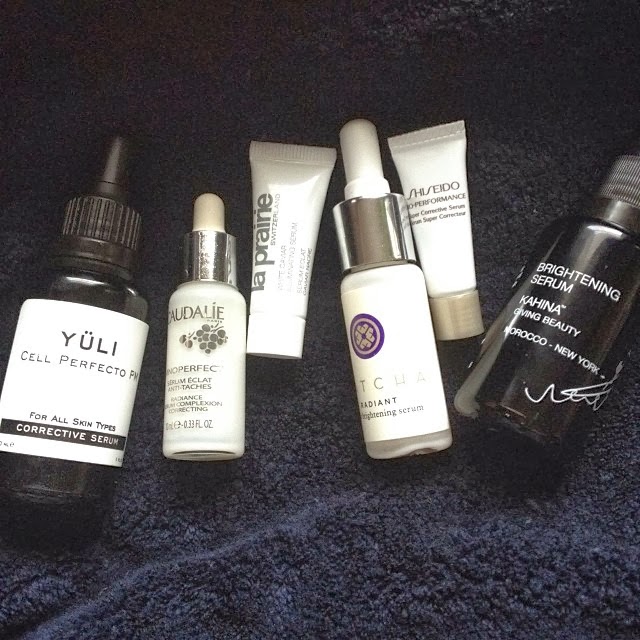
For the past two weeks I've been playing with a variety of the most raved about brighteners and correctors from ultra premium brands both green and not green. Brighteners and Correctors are a very complicated category because it is easy to confuse what the products are supposed to do. Brighteners will enhance skin, making it appear more even and "lit", which is beneficial for those who have dull and uneven skin. A lot of brighteners fade color with acids or melanin suppressants. Correctors focus on the damaged skin that contributes to the flawed complexion so they work on turning over damaged skin and making it healthy and normal again. Results usually come more quickly with brighteners because they are meant for the more superficial surface level issues while correctors often work on deeper damage.. While it is too early to call out the performers, I thought I'd post a little about the first impressions.
Texture and scent:
Texture and scent:
Shiseido and La Prairie are very similar to each other. Their serums both promise brightening with Shiseido going a step further to offer correcting. They're both light and sink into skin easily thanks to alcohol and silicones which there is a lot of. The fragrance is as expected for a high-end brand. La Prairie has sparkle pigments that resemble a subtle glitter bomb which probably gives a temporary luminosity to skin until it is washed off.
Caudalie and Tatcha are very similar in that theirs are both very fluid, milky serums with nice fragrances. The fragrances Caudalie uses in their products are so good that they've been bottled into perfumes but unfortunately, similar to Shiseido and La Prairie, they're synthetic while Tatcha uses natural fragrance.
Kahina is also milky but a little thicker than the others. The scent is very light compared to the others but there does seem to be a mint smell.
Yuli has a plant oil base but the texture is actually more of a clear gel because of the other ingredients. This gel texture enables some material to be suspended which supposedly gives off activity over time and is supposed to be massaged onto skin to penetrate and stimulate - smart! The scent is herbal and light.
Skin Response:
After initial tests and 2 week trial runs, if I were to pick the ones that I predict would deliver the most results with extended use, I would say Tatcha's Deep Brightening Serum and Yuli Cell Perfecto. These two felt like they did the most in this short amount of time so I think given a more extended run, the results will probably keep coming.
I'll post a full rundown on these products when I've had more time but for those of you looking for some direction now, I thought this might be helpful.
Sunday, December 22, 2013
My take on Colloidal Silver
I have been receiving e-mails for a while now asking about colloidal silver; whether it is safe, if it will turn skin blue, and so forth. The natural beauty community seems to have a neutral to negative take on this ingredient based on comments I've read online. So rather than me writing out what I know about colloidal silver, I thought it may be more productive to directly answer or examine some beliefs about this ingredient.
What is it?
Think of colloidal silver as a suspension of tiny silver particles evenly dispersed in water.
What does it do?
Colloidal silver is used for many reasons, however in skincare products, it has an anti-bacterial and anti-viral function that acts as a natural preservative and helps to kill bacteria.
What is the problem with it?
For most people, the problem has more to do with the past than with the product itself. When it first came out, there were all sorts of health claims for colloidal silver including as a dietary supplement, HIV/AIDS cure, herpes vaccine, etc. However much of these claims are unsubstantiated through scientific testing. Furthermore, there were no dosages so people ingested large quantities to cure everything from the common cold to allergies. The build up of large doses of colloidal silver when ingested over time can lead to a condition called Argyria, which gives a blue discoloration to skin, eyes, nails, and other membranes. Argyria doesn't have any real health impacts although the appearance can be extremely disconcerting.
So what happened?
Because of these isolated cases, the FDA realized that there needed to be measures in place as this was being used as a form of oral medication without any tested medical results to back the claims. After testing, they concluded that much of the claims could not be proven true and enacted sweeping measures to restrict all manufacturers of colloidal silver who made these claims.
Why are some skincare brands using it now?
Although colloidal silver has never proven to be a legitimate source of fighting off the claims manufacturers initially suggested, it does have real efficacy as an anti-bacterial that inhibits the growth of bacteria, germs, and viruses. As it is a pure and clean ingredient (using only silver), it is considered a very natural preservative.
Why don't they use other preservatives?
As a preservative, colloidal silver delivers great results and is also fairly beneficial for the skin. This makes them exceptional as they have dual functions to both protect the formula from spoiling and provide benefit for skin. It seems that commonly detractors of any ingredient in natural beauty will make the following claims: 1) The ingredient is cheap 2) It isn't pure/natural 3) It is bad for sensitive skin!
So let's address those claims:
1. Colloidal silver is much more expensive than typical food grade preservatives (which are in turn more expensive than paraben/phenoxyethanol) because of the fact that it is a high quality and effective ingredient that uses actual silver. There I don't believe skincare lines use this ingredient to skirt the issue of cost.
In fact there is nothing budget-friendly about colloidal silver at all, the recently launched La Potion Infinie Argentum is a $245 jar of cream that is said to have anti-aging, hydrating, and anti-bacterial impact on skin. It's key ingredient is colloidal silver. Similarly, Julisis, another expensive line uses colloidal silver across its silver essence line. In this case, they're showing off their access to and use of colloidal silver as an attractive ingredient.
3. Unless you have an actual allergy to colloidal silver, then it won't irritate your skin. In fact many food good preservatives have been shown to have the potential to cause irritation, eye allergies, dermatitis in smaller concentrations.
But aren't other preservatives safer?
Much of the safety concern related to colloidal silver applies to extreme cases of regular ingestion. No such results have ever occurred from topical application because it just isn't realistic. This fear is akin to the fear of contracting HIV from mouth-to-mouth contact, it is misguided. Furthermore, if we're going to access safety through regular consumption, food grade preservatives don't fare any better. For instance, sodium benzoate which is used in Kahina products has been shown to have potential carcinogenic effect when combined with Vitamin C, and in large doses can impact nerve health (this was the ingredient that got Skinnygirl Margaritas into trouble a while back). Benzyl Benzoate used in Tata Harper products has been used in insecticides and has been shown to have potentially irritating effects including dermatitis on human skin.
The takeaway is that none of these preservatives are meant to be ingested straight, so when it happens there may very likely be side effects that aren't favorable. The point isn't to say other preservatives are worse, but rather to point out colloidal silver is not more dangerous than any of the other preservatives most consumers including natural green beauties happily use every day.
So why does the FDA go hard after this?
The FDA goes hard after those who continue to market colloidal silver as an oral medication that cures those unproven claims, not skincare companies who use colloidal silver as a preservative. In the same way that if the ingestion of the food-grade preservative potassium sorbate took off for unproven claims, the FDA would probably go after that as well.
On the flip side, the FDA has approved MANY products that incorporate colloidal silver for its anti-bacterial properties.
What is your take?
The pictures of people with Argyria are hard to look at, so I get the fear. But all those cases came about from a lack of education, we're more educated now. And we now know that Argyria comes from chronic long term ingestion of colloidal silver, not through topical application of skincare. With the sufficient studies that the FDA has done for the approval of topical usage of colloidal silver, I'm very comfortable with this preservative. Colloidal silver helps to maintain the stability of products and unlike most preservatives, actually seems to have skin benefits. If you're not comfortable with colloidal silver yet, look for formulas where it is listed toward the end of the ingredients listing as those concentrations are incredibly harmless.
Wednesday, December 4, 2013
Do toners do anything?
"It seems every line is coming out with a toner/spray for face. Can you tell me if this is needed? I've heard that toners are either essential or a total waste of money, and I'd like to hear your thoughts. La Bella Figura and May Lindstrom have both said in the past that these sprays essentially don't do anything, yet they both have sprays now so I'm a little confused. Are they trying to make money or should I expect to see benefits?"
- Jasmine
Hello Jasmine, I get this question a lot. First let's figure out what toners are because the definition is a bit loose. Toners have an umbrella term that represents astringents, make-up removers, and primers for serums. Classical toners tend to have a high alcohol composition which helps as an additional cleanse. This helps remove impurities so serums can better penetrate the skin. Fancier toners will also have extracts that are beneficial to skin to ideally make it more receptive to moisture and treatments. Green beauty toners are often formulated with floral waters which in my opinion excel beyond the classical toners because they're much more nutrient rich which means your skin can receive more benefits.
Now - what do they do? In the way that a cleanser should cleanser, a moisturizer should moisturize, a toner would tone. This means ideally it should help condition your skin which can include any of the following:
- improving moisture levels and hydration retention
- enhancing skin texture
- managing complexion
- refreshing dull skin
- increasing absorption rate of serums
Personally, I believe a well formulated, high quality toner is very helpful for good skin and I use them in my daily regimen. I won't argue with those who say it is a waste of money because toners don't give instant results that cleansers or moisturizers do, where with those products you'll feel cleansed and moisturized, it's hard to quantify the feeling of "toned". I will say this, I consider a good toner essential to giving me my best skin and going without it does indeed hinder the performance of every other product in my regimen. I can see/feel when my skin getting better after regularly using a toner versus when I do not. It's the subtleties. I consider it similar to drinking tea and juices, your skin is not going to show anything right away but stick with it and your skin will get that glow. Juicers and tea drinkers should know what I'm talking about.
As for La Bella Figura and May Lindstrom, I can't tell you what their intents are but if they said that, I'd guess that it's a mix of the two. Perhaps they changed their minds from when they originally had that stance and they now believe that toners are effective products. It sure doesn't hurt that they're selling a product. I do think it's a bad business move for them ti say that and then end up producing a toner, because it makes me wonder how authentic it is when they champion their product when they don't even seem to believe in it. Though keep in mind that neither of these brands have a dermatological or chemistry background so perhaps as they gained more experience in this field and had exposure to more information, their perspective on this changed. I'd respect them more if they didn't disparage this when others were selling toners but are now fully embracing it when they have a toner to sell.
Regardless, some good ingredients to look for in toners depend on your skin type. Firstly, I recommend floral waters because they contain a lot of nutrients including antioxidants and minerals that your skin can absorb. Look for the ingredients that can have anti-inflammation properties because it helps counter all types of problems like aging, redness, and breakouts. I personally don't like for toners to contain any oils because it should be light. In order to use oils (which are mainly used for fragrance) and maintain a light texture, toners often use emulsifiers and my personal philosophy is that there should not be too many chemicals in the toner especially if it is a spray since you will ingest some of it (through your nose). For dry skin, look for hyaluronic acid that is biologically identical to the ones already present in our skin, as a lot of chemical hyaluronic acid is actually not able to be effectively absorbed. Go for smaller particles that will absorb easily into skin, try to stay away from alcohol not only for what it can do to skin but the fact that it also destroys beneficial ingredients. Because this is a very pure product, try to buy products where the first five ingredients are organic or wild grown.
Beyond this guideline, I'd urge you to give toners a good long test run to help make up your mind.
Saturday, November 23, 2013
Greatest Pet Peeve: Sensitive Skin
There is perhaps no statement that causes me to to shut down quicker than when someone says "I have sensitive skin". This most happens when asking for product recommendations or general advice on skincare. While I know nothing is meant by this comment, from a professional perspective (and hearing it ALL THE TIME), I can't help but have a visceral reaction to it. I urge you to read this with an open mind if you've used this phrase before with your dermatologist because it could help you communicate better with your dermatologist. Here's why:
It doesn't mean what you think it means. Sensitive skin is actually more of a marketing term that some companies used in the early 90s that really took off. Initially the intention was to sell products that would relieve redness and inflammation. But consumers took this phrase and through a continuous consumer-led cycle redefined this to stand for "products suitable for sensitive skin", giving the impression that sensitive skin is a "skin category" - which it isn't. The skin is a spectrum and there is no set guideline for when it is sensitive and when it is normal, after all, do you ever hear the phrase "products suitable for insensitive skin"?
- It is a non-quantifiable word that is utterly meaningless in helping me access and diagnose your skin. Sensitive skin means your skin has had a sensitivity to something (if it does not, you shouldn't say you have sensitive skin).Those who have skin that is reactive to lot of products most often have a sensitivity to a common ingredient. It is not helpful to say you have sensitive skin but if you can follow it with what you are actually sensitive to (synthetic fragrance, silicones, etc), and what it does to your skin, that would help.
- It is overused. 80% of women claim to have sensitive skin, if we were to take this statistically, it really means the "majority of people have sensitive skin" which given the definition of sensitive is statistically impossible. The real world implication is that most people who say they have sensitive skin just have normal skin since they're in the majority. This really just goes back to my former statement that there is no quantifiable measure for sensitive skin so everyone uses it in different ways that in the end don't really represent anything.
So think about it from your dermatologist or skincare professional's view. 8 in 10 patients they see say their skin is sensitive, after a while of this what this means is that they're numb to the word rendering it ineffective. Anyone can have a sensitivity to anything. I once heard a girl say her skin was allergic to water, true story. So whether a patient reports having sensitive skin or not, as dermatologists we still have to go in preparing for the possibility that there are some things you could be sensitive to and some things you won't be.
Psychologically, the reason a lot of people use sensitive skin, is as a crutch against the possibility of an adverse reaction and for companies/professionals to provide more accountability/attention to their specific skin history. So although the word to us is meaningless, when we hear someone use it, we're already mentally categorizing the patient as potentially high-maintenance and problematic. For the patient, using this strategy is also not advantageous because most of the time the response you'll hear back is "then use less of this product" or "discontinue use if irritation occurs" which is pretty general knowledge that should be a given.
So next time you visit your derm or talk to a skincare consultant, try to explain what you mean if you truly believe your skin is "sensitive" - what is it sensitive to? what are the ingredients you need to avoid because of this? what are the reactions and what interactions do you believe led to this reaction? The result is that you'll give us more to work with so we can better help you and you'll actually end up getting the information you were looking for.
So next time you visit your derm or talk to a skincare consultant, try to explain what you mean if you truly believe your skin is "sensitive" - what is it sensitive to? what are the ingredients you need to avoid because of this? what are the reactions and what interactions do you believe led to this reaction? The result is that you'll give us more to work with so we can better help you and you'll actually end up getting the information you were looking for.
Monday, October 21, 2013
Get skin ready for Fall-Winter
Break out the sweaters, fall is here! It's a season I've come to love as it means I can walk along to campus to gorgeous autumn foliage. It also means that it's time to transition your skin care. I've compiled some tips to help prepare your skin for the colder months to ensure you maintain that radiance.

1. Humidifier
Winter is notorious for dry and chapped skin. Invest in a quality humidifier to put moisture back into the air. Not only is this wonderful for maintaining skin moisture, it also keeps your immune system in shape to fend off the spread of seasonal diseases and viruses. I personally prefer the humidifiers that allow you to adjust strength and temperature because there is no "one size fits all". I like to set the humidifier slightly hotter than room temperature so that I don't need to use the heater as much which helps maintain the natural moisture in the air.

2. Exfoliate
It's not just the lack of sun making you feel that your skin is more dull and lifeless during the colder months, its actually the combination of the drier climate and application of more occlusive moisturizers that can keep dead skin cells from turning over. This contributes to the dull, sallow complexion and can even clog pores. May Lindstrom's The Clean Dirt is one of the most well known green exfoliators out there. Some people call this a cleanser, she calls it a cleansing clay, but I think of it as a clean version of Bobbi Brown's Buffing Beads except with spices to stimulate circulation. This is sure to slough off dead skin cells. Sensitive skins should not use this more than twice a week to prevent the possibility of irritation.
 |
| Photo from Eva Chen's Instagram |
3. Face Oil
I was surprised to see on my instragram feed over the weekend that Lucky's new EIC, Eva Chen posted the above picture with the caption: I know it's officially fall when I start using face oils. These are my four favorites!
It's good to see a face oils get recognized in the mainstream because they're so efficient. A few drops provides the moisture capabilities of a moisturizer while also feeding skin with a lot of nutrition. It is really the best combination of a serum + moisturiser. And because it is so pure and concentrated, the chances of congestion and irritation are actually less than using a cream moisturiser which tends to use more chemicals, emulsifiers, waxes, etc which can clog pores and irritate skin.
To read more about picking oils, read my post on how not all oils are equal and for those with acne-prone skin who are taking the plunge into oils, this is a list of recommended face oils.
 |
| Photo from YULI's Facebook |
4. Anti-irritants
Our skin is sensitive to temperature extremes. In brisk, harsh cold climates, the winds and snow can feel like whips lashing against the delicate skin. I remember a key sign of winter when I was a child was when my dad would bring home hand balms. Balms not only help skin retain moisture, but their thick barrier also forms a protective shield against the harsh environmental exposure.
I really like YULI's Cocoon Elixir because it contains anti-irritants that help to relieve redness and soothe skin with calming calendula, chamomile, and healing lavender. And for when skin is really problematic, it contains anti-inflammatories to treat those painful itches caused by dry harsh air.
 |
| Photo from Salonzola Instagram |
5. Protect your lips
This should be obvious as your lips are one of the most exposed parts of your face. To prevent chapped, dry lips, I recommend an occlusive balm. A personal favorite is Intelligent Nutrient's Lip Delivery which features beeswax, coconut oil, and shea butter which are among the most powerful moisture retaining ingredients by far comparable to even their chemical sibling petrolatum. I also love that besides just waxes and thick oils, it has antioxidants and real nutrients which makes it almost like a balm-serum.
 |
| Photo from I Am Natural Instagram |
If your lips are beyond the need for a simple moisture fix, use YULI's Cellular Lip Conditioner to heal and treat dry/cracked lips and layer it under your balm to fix damaged lips and soak in moisture. It's called a super-concentrated lip serum which means there are more actives that repair lips beyond forming a barrier.
Both products are not only natural & mostly organic but they're food-grade and safe enough for pregnant women which is so important because upwards of 80% of lip products are ingested.
 |
| Photo from Clementine Fields Instagram |
Everyone should use a moisturiser but if you have dry skin, it is even more important to step up moisturisers in the winter to keep your skin in check. I personally like Tata Harper's moisturisers, I buy the Repairative Moisturiser (above) for my mom as it is suited for dry/mature skin, while during the coldest bits of winter, I apply a pump of the Rebuilding Moisturiser over dry patches around my mouth. My favorite quality about the moisturisers from this line is that they're packed with skin restoring ingredients. Some moisturisers just help lock in hydration but Tata definitely makes hers a hybrid between moisturiser/anti-aging treatment. I almost see no need to add an anti-aging treatment on top of her creams for this reason.
Some people don't like that the Tata Harper line is very fragrant but I consider it a step above other companies that use parfums (synthetic fragrance). So if you don't have any sensitivities to the fragrance she uses, I consider her moisturisers really effective for dry skin.
--
Have any questions over how to transition your skincare regimen to winter? Ask in the comments!
Thursday, October 10, 2013
Green Beauties, Your Makeup Could be Causing Your Breakout
One of the greatest ironies I see in the green beauty world is women with acne switching to green makeup in hopes of getting their skin under control. While it is true that mainstream beauty brands use more chemicals and toxic ingredients, what causes acne are suffocating or irritating ingredients such as fragrance, mineral oil, and silicones. All this aside, switching from these ingredients to lines that use coconut oil and waxes is not going to be better for your skin.
I would almost say as a rule that if you have blemish prone skin, do NOT use RMS Beauty which uses coconut oil in nearly everything. My parents have seen many patients who go to them with massive clogged pores and breakouts after switching to "holistic natural" products and cleansing/moisturizing their skin with these thick oils. I'm not saying coconut oil is a bad ingredient, not at all, if you have dry skin or skin that just doesn't break out, you will even find it to be very useful but for people who break out, you should absolutely refrain from using this on your skin. The moisturizing properties aren't worth it because it will break you out eventually.
So that is makeup itself, now let's talk about how we remove makeup. Many green beauties swear by oil cleansing. I can see why, it works wonders in removing stubborn makeup as the oil pulls products from skin that water cannot. However, if your skin is prone to breakouts, I would definitely advise against just oil cleansing. No matter how well you wash, there will be residue left over that accumulates in your pores leading to more breakouts down the road. If you want the performance of a oil cleanse, I suggest the double cleanse method. Use an oil to clean your face, wash it as much as possible. Then go over it with a traditional cleanser that can take off the left over oil and actually clean out the other grime in your skin that oils do not remove.
Remember that just because something is holistic and green, it doesn't mean that it is suitable for you. Acne is a treatable condition, for most people who have those persistent but not severe types of acne, it is nearly always preventable by changing a few things in their routine.
Monday, September 30, 2013
September Reader Questions
I'm trying my best to answer all of your e-mails but it can be challenging to answer product specific questions for things that I have not used before, and I try to frame my answers as objective and well researched as possible. From your questions it definitely seems that citrus oils and sun protection is a big question in the green beauty market. Please note, these are simply my views.
"My sunscreen contains citrus oils, is this okay?"
From: A lot of you!
The answer is that this depends on the product. What is the the sun protection factor, is it a physical or chemical sunscreen, what is the concentration of citrus oils in the formula? A lot of companies use citrus oils because it provides natural fragrance, otherwise many people might be turned off by the natural scent of the cream. Obviously, I would like to use a product that didn't contain citrus oils in my sun protection, but I don't think it will be make a sunscreen bad (especially if it contains a high degree of physical blockers which will guard the photosensitizing ingredients from UV rays).
"I read that ascorbic acid is a cheap form of Vitamin C that isn't complete, is this true? It is in many of the vitamins I take and skincare products that I use."
From: Lara, Mark, and Meghan
I received variations of this question and I just want to get this out there: Ascorbic Acid IS Vitamin C, there is nothing wrong with it and not all forms of ascorbic acid are cheap. This type of erroneous information is why there is perhaps no green beauty company I'm more frustrated with than La Bella Figura. I know that this was part of their campaign to publicize their "non-synthetic" Vitamin C from Kakadu Plum Extract but I've mentioned before how this is a fallacy (see active vs concentration question). While Kakadu Plum Extract does contain a high concentration of Vitamin C, it would be like saying rubbing a lemon on your face is going to be better than using a Vitamin C serum because "it's a non-synthetic, whole source". It's just wrong.
Here are a few of the reasons:
1. Not all of the extract is absorbed into skin and the amount that is contains non-Vitamin C as this is a food product. In fact fiber rich fruits such as this contain mostly cellulose and fiber which is present in nutritional content even in extracts, so a good chunk of the extract is most likely not even active. Versus pure-active Vitamin C ascorbic acid which is shown to deeply penetrate skin.
2. You can't control the concentration of vitamin c in food extracts, and you need a certain percentage concentration to make it effective in topical products.
I really really urge you to think about the qualifications these ladies behind the brand have for developing these products because their haphazard marketing and research has caused so much confusion in the space. So please, the next time before you start calling out perfectly reasonable ingredients, ask yourself where your beliefs came from and how reliable the source is.
"I read about the concern people had for May Lindstrom's The Youth Dew for its citrus oils. May says that the amount isn't significant to cause damage and she has never received a complaint about it. Can you provide some guidance?"
From: Mary, Elise, and Susan
I have tried The Youth Dew and it is a wonderful face oil. Not too heavy, moisturizing, and smells great! In fact when I use it at night, my skin feels very balanced in the morning, can't complain! I probably wouldn't use it during the day time just because there are so many great oils you can use that contain zero photosensitizing ingredients compared to her small but still existent amount. May probably has never received a complaint about this before because it isn't an immediately perceivable issue, like a blemish or skin rash. Dark spots and sun spots can take months and years to form, so by the time you get those spots, you've probably already moved onto another product or you don't even realize what caused it, erroneously attributing it to natural effects. Many many of the patients my parents see come from using products that contain citrus oils across the line such as Ren and they wonder why their skin is so much more prone to developing sun spots - this is why.
Monday, September 23, 2013
Review of Vered Herb Infused Toner

This product is described as "a non-drying face toner that thoroughly cleansers, balances, and nourishes all skin types." Reading this, I believe Vered may have intended this to sort of be an all in one: cleanser, toner, moisturizer. With that said, I don't believe this will be suitable for all skin types, and those with drier skin may likely find themselves reaching for a moisturizer. For my skin, which is relatively normal yet prone to oiliness (men tend to have largers pores, thicker skin, and produce more oil than women due to testosterone), this worked well when used once a day. During my trip with limited supply to water, I saw wonderful benefits to using this twice a day in the morning and before dinner due to the heat/sweating as there was always enough oil/grime/dirt to remove. However at home, I felt that using it more than once resulted in my skin feeling dry and slightly stripped of healthy oils.
Part of the reason for this is because this product relies on a mixed base consisting of alcohol, water, and glycerin. To give her credit, the alcohol is sourced from organic grain alcohol which is a clean form of alcohol but it is an alcohol all the same. I like alcohol for its anti-bacterial nature but it is not the best ingredient for sensitive skin as it can easily disrupt the moisture and lipid barrier. I much preferred the other ingredients Vered chose to use such as the calming calendula, healing echinacea, astringent orange and lemon peel, and soothing comfrey.
For those who might have oily less sensitive skin, I think this would be wonderful. In fact, you'll enjoy the grape juice scent mixed with the very attractive burgundy color of the product. When applied on a cotton round, you can easily see the oil and grime coming off without applying much pressure that may get your face red. I prefer to use this as a pre cleanse after the gym to remove everything while I'm getting ready for a shower, then I use a gentle cleanser to remove whats left of the toner and impurities.
This is a purists toner, a throwback to those days when toners meant alcohol, cotton pads, astringents but that doesn't mean it is a bad thing especially when wrapped in a attractive package that includes organic ingredients that are ethically sourced, high quality essential oils, and a beautiful scent that is sure to put a smile on anyones face. So for anyone transitioning from their La Mer and Clarins make-up removing, astringent toners, look no further: Vered Herb Infused Toner
Thursday, September 5, 2013
My Skincare - Aug/Sept
 |
| L to R: Osmosis Shelter SPF 30, Vered Herb Infused Toner, YÜLI Cocoon, YÜLI M.E. Skin Fuel, Dr.Alkaitis Organic Soothing Gel, Dr.Alkaitis Organic Nourishing Treatment Oil |
I haven't really been updating my blog because I was accepted into a volunteer program for medical students so I have been working at what the team calls a "pre-doctors without borders" environment. It is extremely tough work but not to sound cliche, the feeling of accomplishment in providing medical aid to those without healthcare is even more amazing.
There is a 3 room clinic so most of us work outside in the make-shift tents all day and we have limited source of clean running water that we have to ration. I thought this would be a good post to show how my green skincare regimen provides the versatility and performance that shows how amazing these green products are when put to the test.
There is a 3 room clinic so most of us work outside in the make-shift tents all day and we have limited source of clean running water that we have to ration. I thought this would be a good post to show how my green skincare regimen provides the versatility and performance that shows how amazing these green products are when put to the test.
Cleanse

This is a terrible shot but I was trying to shoot this with my phone in one hand and The Clean Dirt in the other, not easy! The Clean Dirt is great because you just need to splash your face a little bit and ration a little trickle of water to mix the dirt into a paste. It helps to exfoliate skin and break through the dirt. I use this probably three times a week so prevent my skin from looking dull or rough. I didn't bring the full bottle because I tried to travel lightly so I poured these into smaller containers.
Quick Clean: I was sent a full size of Vered's Botanical Herb-Infused Toner which I will review shortly. I find that when water is scarce or I just need a quick clean (often after working an entire day then going directly to a dinner), I dab this liberally over a cotton pad and it takes all the excess oils and dirt off my face.
Sunscreen: My mom carries Osmosis in her office and it is a solid line, though not one for green beauties (for instance, while they don't use parabens, they use a lot of honeysuckle which contains a natural form of parabens that impacts the body in the same harmful way). I like their Shelter SPF30 sunscreen because it's a great physical block that also moisturizes skin. It's one of the only sunscreens that doesn't sting my eyes if I get some in through sweating.
Face Mist: I knew that I would be in a hot and dry climate so I needed something cooling, refreshing, but that could also relieve my skin of sunburn, heat, and environmental irritation so YULI's Cocoon Elixir was the perfect choice. True to it's word, redness and inflammation is calmed down quickly, and let's just say if I ever find this bottle gone, it's usually with one of my fair skinned cohorts who have taken a liking to this. Oh and it feels and smells so good.
Night time: At night I like to use the Dr.Alkaitis Soothing Gel to help keep breakouts from forming and also provide a little moisturization. I also think it's important to have an anti-bacterial product just because things aren't as clean here. If my skin is ever feeling a little warm or exhausted, using this with Cocoon is a sure bet to calm everything down.
Moisturizer:
Body - I like to use Dr.Alkaitis Nourishing Treatment Oil as it is a thicker oil that can feed my depleted, sun-drenched skin. The oil helps dry/damaged skin which is perfect for extremeties that can often be neglected in the heat.
Body - I like to use Dr.Alkaitis Nourishing Treatment Oil as it is a thicker oil that can feed my depleted, sun-drenched skin. The oil helps dry/damaged skin which is perfect for extremeties that can often be neglected in the heat.
Face - I really enjoy YULI's ME Skin Fuel, which besides the superb ingredients which I mentioned here, is very light and balancing. It's perfect for providing skin with nutrients and moisture without weighing it down. I try to put a few more drops around parts that have high sun exposure as this has natural UV protectors. There are a lot of blemish calming ingredients in here and even angry red flare-ups seem pacified after applying this. At the end of a long day, my skin absolutely drinks this stuff up and I wake up with really happy skin.
So this is my routine, relatively low dependence on water and very versatile. Most of all, the performance is amazing. I'm able to finish my routine in 1-2 minutes while everyone else is waiting in line for water. I've also noticed that I'm the only one who hasn't suffered sun burns, acne, or skin flaking this entire trip, so I give a lot of credit to these products.
Subscribe to:
Posts (Atom)